
Why Brands start with a question?
Why-Brands-start-with-a-question? I don't know
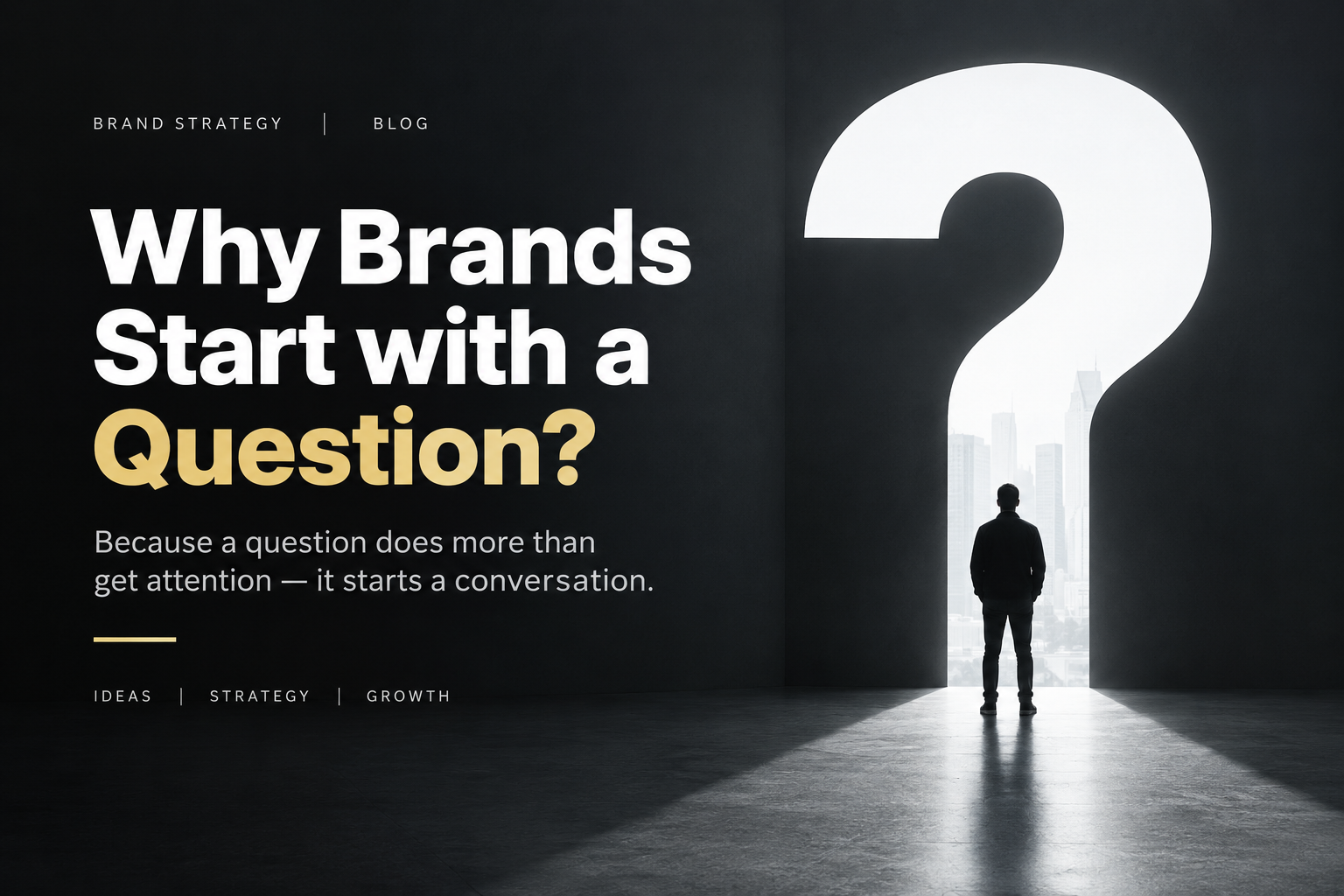
Why Brands Start with a Question?
Most brands start with an answer.
A name.A logo.A colour palette.A product.A tagline.
But the strongest brands often start somewhere else.
They start with a question.
What does our audience actually need?Why does this problem exist?What do people believe about this category?Why should anyone care about what we are building?
Because before a brand can communicate an idea, it needs to understand the idea worth communicating.
A brand is not just what you create
When people think about branding, they often think about the visible parts of a business.
The logo. The typography. The packaging. The website. The Instagram feed.
These things matter, but they are not the brand itself.
They are expressions of the brand.
A brand is ultimately the meaning people attach to a business. It is the expectation they have, the feeling they associate with it, and the reason they remember it instead of choosing someone else.
That means branding cannot begin with:
"What should our logo look like?"
It needs to begin with:
"What should this brand mean to people?"
And that question leads to many more questions.
Questions uncover the real problem
Imagine someone wants to start a coffee brand.
The obvious approach is to ask:
"How can we sell coffee?"
But a strategist might ask something different:
"Why do people choose one coffee brand over another?"
Then another question appears:
"Are they actually buying coffee, or are they buying convenience, status, comfort, routine, or an experience?"
Suddenly, the problem becomes much more interesting.
Maybe the opportunity isn't to create another coffee brand.
Maybe it is to create a brand for people who want exceptional coffee without the intimidating culture surrounding specialty coffee.
That changes everything.
It changes the product experience.
It changes the messaging.
It changes the visual identity.
It changes the packaging.
It changes the content.
The question didn't just help define the marketing.
It helped define the brand itself.
The right question can change the direction of a brand
This is where strategy becomes important.
A business can spend thousands developing something that nobody really needs.
A beautiful identity cannot fix a meaningless proposition.
A sophisticated website cannot fix unclear positioning.
And a large advertising budget cannot create genuine relevance where none exists.
Questions force us to slow down before we start building.
Instead of immediately asking:
"What should we make?"
We can ask:
"Why should this exist?"
Instead of:
"How do we get more customers?"
We can ask:
"Why aren't the right customers choosing us?"
Instead of:
"How can we make our competitors look worse?"
We can ask:
"What can we own that they don't?"
These questions move the conversation from execution to strategy.
Great brands understand people before they talk to them
A brand doesn't communicate in a vacuum.
It communicates with people.
And people don't make decisions purely based on product specifications.
They have frustrations, ambitions, habits, fears, preferences and beliefs.
A good brand understands those things.
Consider a fitness brand.
It could say:
"We offer high-quality fitness equipment."
There is nothing necessarily wrong with that statement.
But it doesn't tell us much about the person buying it.
What if the real audience is people who want to become healthier but don't feel comfortable in traditional gyms?
Now the strategic question becomes:
"How can we make fitness feel accessible to people who don't identify as fitness enthusiasts?"
That's a much stronger starting point.
The product may remain similar.
But the brand's role becomes completely different.
It is no longer simply selling equipment.
It is helping people feel that fitness belongs to them too.
That is positioning.
And positioning starts with questions.
Questions create differentiation
One of the biggest problems in modern branding is sameness.
Open Instagram and look at businesses within the same category.
You will often find similar colours.
Similar typography.
Similar photography.
Similar slogans.
Similar content.
Similar promises.
Everyone is trying to look professional.
Everyone is trying to look premium.
Everyone is trying to look modern.
The result?
Nobody stands out.
The problem isn't necessarily bad design.
The problem is that the brands may not have asked a difficult enough question.
If your strategy begins with:
"How can we look premium?"
You will probably end up looking like other premium brands.
But if you ask:
"What does premium actually mean to our audience?"
You may discover something completely different.
Maybe premium means simplicity.
Maybe it means personal attention.
Maybe it means exclusivity.
Maybe it means reliability.
Maybe it means never having to think about the problem again.
The question creates the insight.
The insight creates the strategy.
The strategy creates the identity.
And the identity creates consistency.
The best questions are uncomfortable
Not every useful question has a comfortable answer.
Sometimes the most important question for a brand is:
"Do people actually want what we're offering?"
Or:
"Are we solving a real problem, or are we solving a problem we invented?"
Or:
"Would people miss us if we disappeared tomorrow?"
Or even:
"If our logo disappeared, would anyone recognise what we stand for?"
These questions can be uncomfortable because they challenge assumptions.
But that is exactly why they are valuable.
Strategy isn't about confirming what a business already believes.
It is about discovering what is actually true.
Questions also help brands evolve
A brand is not something that gets created once and then frozen forever.
Markets change.
People change.
Technology changes.
Competitors change.
Culture changes.
The questions a brand asks therefore need to change too.
A company that once asked:
"How can we make this product available to more people?"
may eventually need to ask:
"What does our customer need from us now?"
This is one reason successful brands continue to research, listen and adapt.
They don't assume that yesterday's answer will always work tomorrow.
They keep asking.
From question to strategy
A useful brand-building process can often be simplified into a chain:
Question → Insight → Strategy → Expression → Experience
It starts with a question.
That question leads to an insight about the audience, market or problem.
The insight informs the strategy.
The strategy determines how the brand should communicate.
And that communication becomes the experience people have with the brand.
This is why branding is much bigger than visual identity.
The logo might be the first thing people see.
But the strategy is what determines why that logo exists in the first place.
So, what question should your brand start with?
There isn't one universal question.
It depends on the business.
But some of the most useful starting points are:
What problem are we really solving?
Who are we solving it for?
Why does this problem matter to them?
What are people currently doing instead?
What frustrates them about existing solutions?
What do they expect from brands in this category?
What could we do differently?
What could we become known for?
Why should someone choose us instead of the alternative?
And perhaps the most important one:
If this brand didn't exist, what would people actually be missing?
The answers to these questions are far more valuable than starting with a colour palette.
A brand doesn't need to have all the answers immediately
Starting with a question doesn't mean a brand needs to know everything.
In fact, it means the opposite.
It means being willing to investigate.
To listen.
To challenge assumptions.
To test ideas.
To learn from customers.
To look at competitors.
To understand culture.
To find the gap between what people have and what they actually want.
That process is where strategy comes from.
And strategy gives creativity something meaningful to express.
The question comes first
The next time you see a brand with a beautiful identity, don't just ask:
"How did they design this?"
Ask:
"What did they understand before they designed this?"
Because behind every strong brand should be a strong idea.
And behind that idea, there is usually a question.
The logo comes later.
The colours come later.
The campaign comes later.
The content comes later.
First, you need to know what you're trying to solve, who you're trying to help, and why anyone should care.
That's why brands start with a question.
Because the right question doesn't just give you an answer.
It gives your brand a reason to exist.
Enjoyed this? Share it.